1. Before filing
Define your activities, owners, business name and operating location. Check professional ownership restrictions and compare legal structures. An LLC is a choice to evaluate, not a requirement for every business.
Use this practical path to move from idea to registered, tax-ready and locally compliant. Each requirement links to an official source, with optional tools clearly separated from government filings.
Last reviewed October 14, 2026 · Requirements can change; verify before filing.
Use this order alongside the detailed checklist below. Work on independent tasks together, but confirm approvals before committing money or opening.
Define your activities, owners, business name and operating location. Check professional ownership restrictions and compare legal structures. An LLC is a choice to evaluate, not a requirement for every business.
Describe the exact activity to planning or zoning and the industry regulator. Ask about permitted use, occupancy, inspections and approval timing before committing to premises or renovations.
Complete applicable entity, name, tax and operating registrations. Confirm taxability, required customer documents and insurance. Test payments, receipts and customer follow-up before launch.
Resolve worker classification, employer accounts, payroll, new-hire reporting and coverage. Check industry staffing and background-check requirements before anyone starts.
Choose the closest fit to see the questions to resolve and the official places to start. Keep the full launch sequence below for formation, names, banking and ongoing compliance.
Answers and checkmarks save on this device when browser storage is available. No account is required. This is an educational starting list, not a complete licensing search or a determination of your legal, tax or insurance obligations.
Our 15-question assessment checks the offer, demand, pricing, setup, money and customer plan. Use it before formation—or anytime you need to identify the next weak point.
Pennsylvania assistance · Official notice October 27, 2026 · Checked October 28
SBA disaster assistance is available for eligible losses from September 12–20, 2026 flooding in Washington County and surrounding Allegheny, Beaver, Fayette, Greene and Westmoreland counties. This is a southwestern Pennsylvania declaration, not a statewide or NEPA offer.
These are loans, not business grants. Review physical-damage and economic-injury eligibility separately.
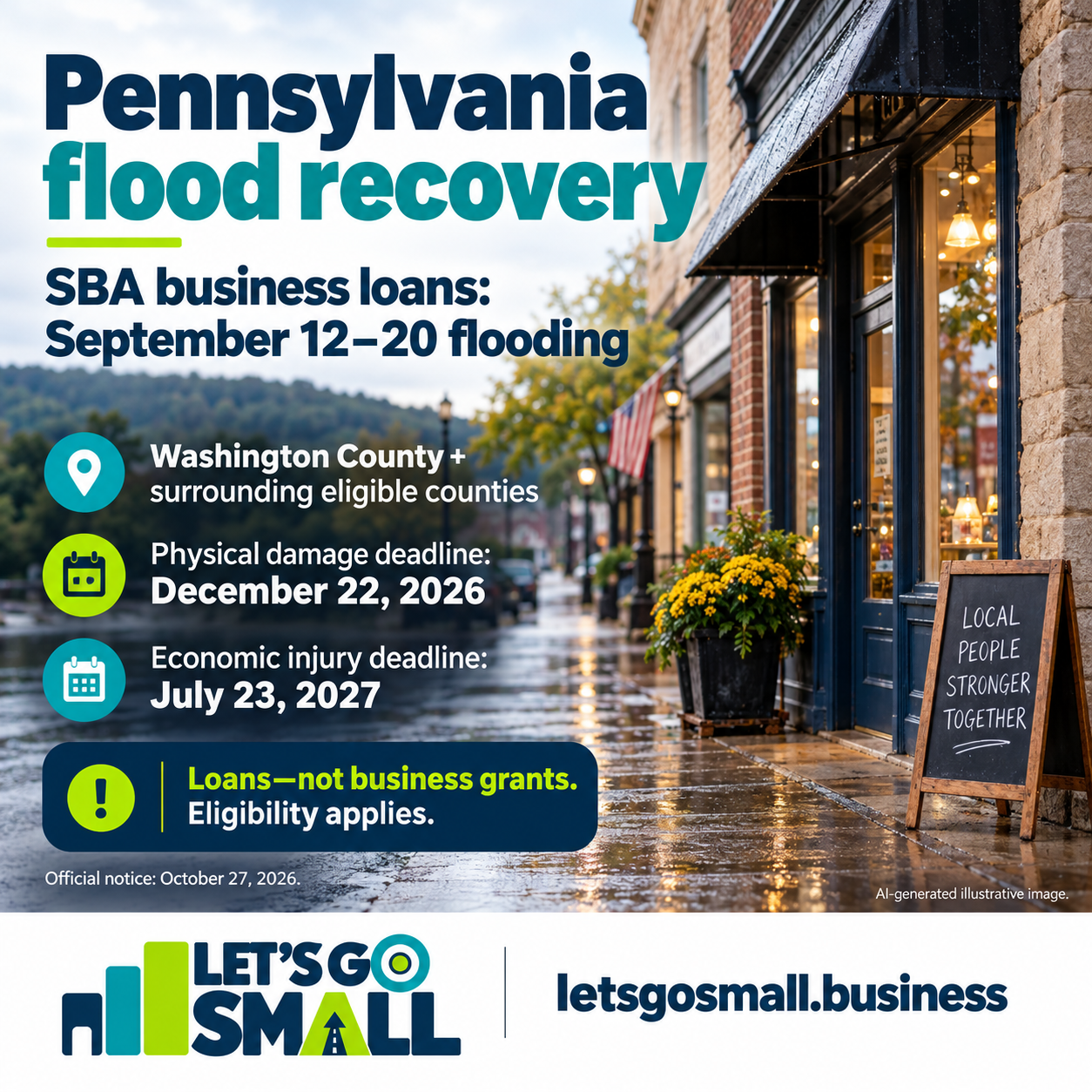
Check the declaration and application instructions, document losses and insurance information, and confirm which deadline applies. The separate Commonwealth DRAP grants described in the notice are for eligible households, not an ordinary business-grant program.
Read the official notice & application routes ↗
No affiliate links in this assistance notice. Let’s Go SMALL does not decide eligibility, charge an application fee or guarantee funding.
Local contracting opportunity · City notice October 27, 2026 · Checked October 28
The City’s Taking Care of Business program seeks qualified nonprofit organizations as direct applicants for commercial-corridor sidewalk cleaning. Some participating nonprofits employ their own cleaning teams; others subcontract with local cleaning companies.
For an ordinary cleaning business, this is a possible relationship-building route, not a guarantee of a subcontract or direct eligibility.
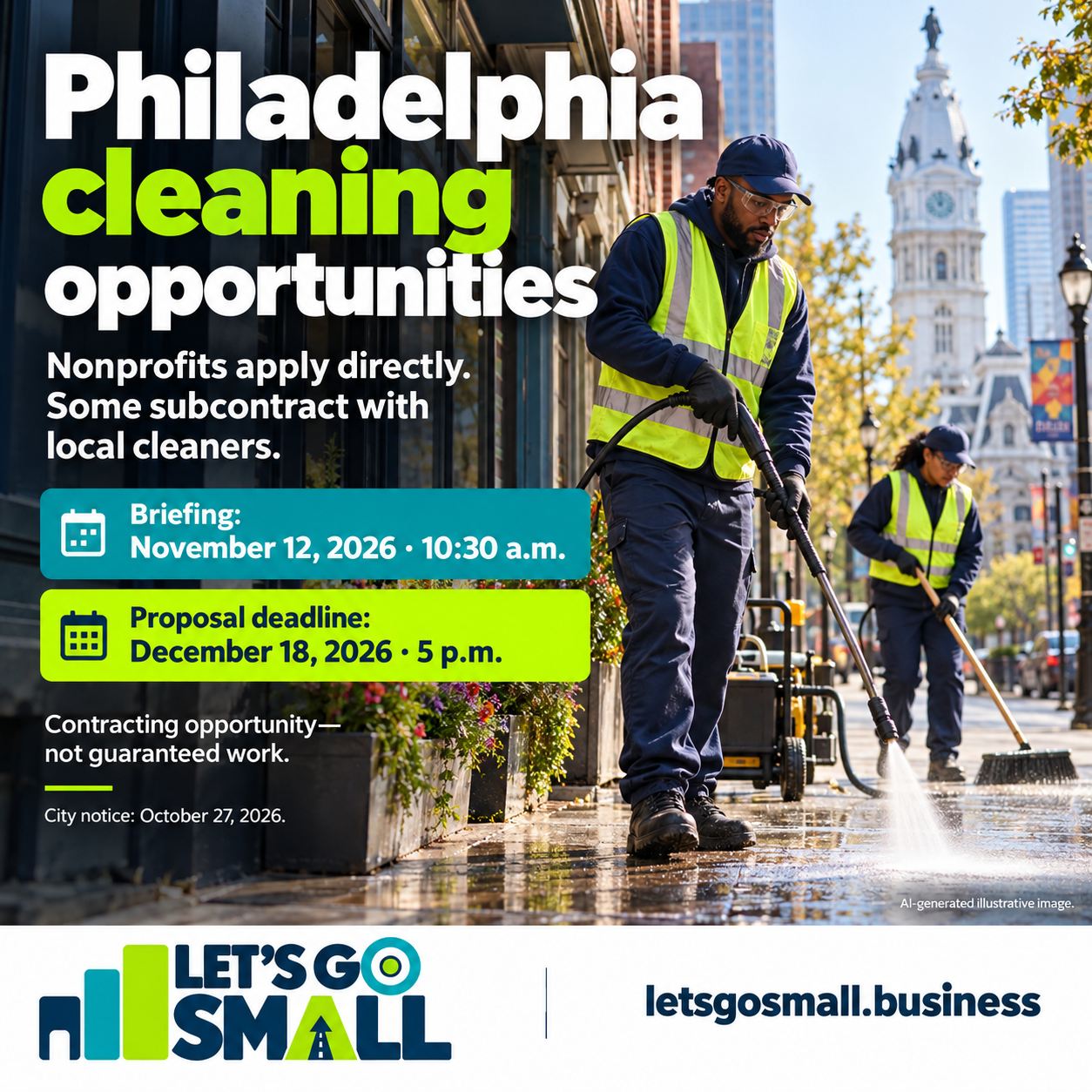
Describe the neighborhoods you can serve, equipment, capacity, references and insurance information. Read the full requirements and approach qualified nonprofit organizations about their procurement process. Do not represent yourself as a nonprofit unless that is your organization’s actual status.
Read the City’s RFP announcement ↗ Build your service-business marketing basics →
Opportunity information only. No guaranteed award, work or income. General education, not individualized contracting or legal advice.
Review open programs for child-care providers, urban agriculture and creative businesses, plus dedicated funding guidance for Pennsylvania farms and agricultural businesses. Each listing includes the exact deadline, practical eligibility notes and an official source.
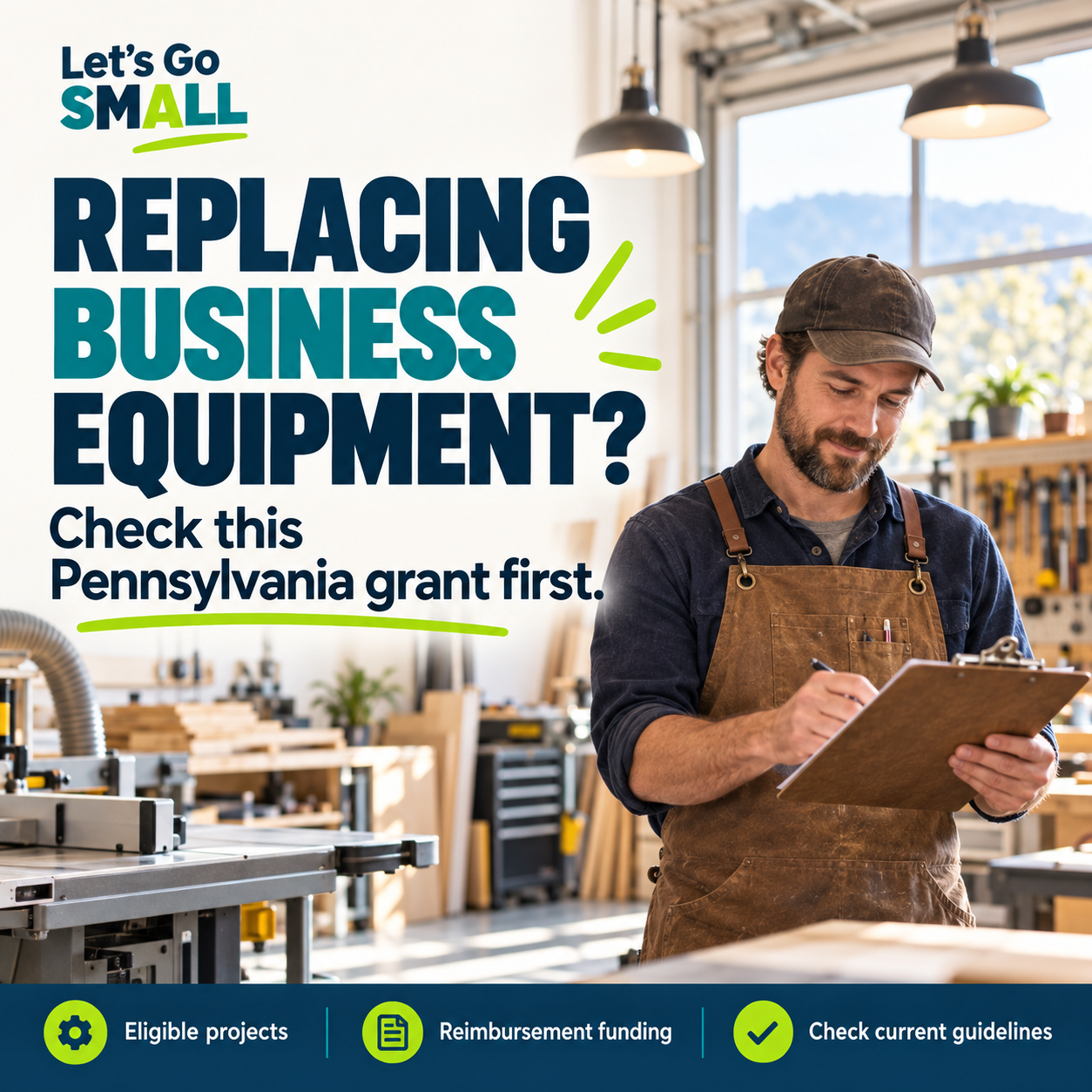
Pennsylvania’s 2026–2027 Small Business Advantage Grant offers reimbursement of 50%–80% of eligible project costs. Maximum awards range from $7,500 to $12,000, depending on project impact and location. This is project funding, not unrestricted startup cash.
Before committing: check the current guidelines, project dates, eligible costs, required match, reimbursement process and evidence of projected savings. Applications are considered first-come, first-served; an open listing does not guarantee remaining funds or approval.
Official source: Pennsylvania DEP. No affiliate link or application fee is charged by Let’s Go SMALL.
Answer five quick questions for a focused reminder list. This tool does not determine your filing obligation; verify the official instructions or ask a qualified tax professional.
Valid extensions for many 2025 individual and calendar-year C-corporation returns end October 15. Monthly payroll depositors may also have a September employment-tax deposit due. Pennsylvania’s guide lists the October 15 personal-income-tax extension deadline and a nonresident-withholding installment for certain pass-through businesses.
Businesses and private nonprofits in Blair, Cambria, Cameron, Centre, Clearfield, Clinton, Elk, Indiana and Jefferson counties affected by the July 28, 2026 severe storms and flooding can apply for SBA physical-disaster loans through October 19, 2026. The economic-injury deadline is May 19, 2027.
Official SBA notice →Check off items as you work. Progress stays in this browser. Some steps are conditional because the correct path depends on the business activity, location, ownership and whether anyone is hired.
Define the customer, test whether people will pay, estimate startup cash and calculate what remains after delivery costs, fees and taxes.
Do before filingCompare a sole proprietorship, LLC and corporation based on liability, ownership, administration and tax treatment. An LLC is a legal structure; its federal tax classification is a separate question.
Search Pennsylvania records before filing. A business operating under a name other than its legal or proper name generally must register a fictitious name. Registration does not create a separate entity, liability protection or trademark rights. If an individual is listed in the fictitious-name filing, Pennsylvania requires official publication.
Conditional requirementFor an LLC, corporation or other structure requiring entity registration, file directly through Pennsylvania Business Filing Services or use paid administrative help if desired. The current state fee for a domestic LLC Certificate of Organization is $125. Keep the approved filing, entity number and governing documents together.
State filingForm the legal entity first when applicable, then request the EIN. The IRS issues EINs free; avoid websites that make a free government application look like a required paid service.
FederalUse myPATH for Pennsylvania business-tax registration. Possible accounts include sales and use tax, employer withholding and unemployment compensation. Do not collect sales tax before understanding whether the product or service is taxable and where the sale is sourced.
Activity-dependentAsk the municipality where work is physically performed about zoning, home-occupation, occupancy, signage and local licensing. Regulated professions and certain industries have additional state requirements. DEP’s Permit Navigator can flag possible environmental permits, but it does not decide whether a permit is required or cover municipal approvals.
Location and industry dependentUse a dedicated business account, record income and expenses consistently, and review coverage for liability, property, vehicles, cyber risk or professional services. Entity formation does not replace insurance.
Classification, payroll registration, local withholding and workers’ compensation should be addressed before work begins—not after the first payday. See the hiring section below.
If hiringSecure the domain, publish a clear page, set up business email, payments and a simple follow-up process. Product businesses should also plan shipping, returns and sales-tax operations.
Different laws can apply different tests. Pennsylvania unemployment-compensation guidance starts with a presumption that a paid worker is an employee unless the business can show both freedom from control or direction and an independently established trade, occupation, profession or business. Construction has additional requirements.
A reminder from the state is helpful, but not receiving one does not remove the filing obligation. Keep the registered-office address and notification email current.
Most for-profit reports cost $7. The first report is due in the calendar year after formation or foreign registration.
Official annual-report instructions →Beginning with reports due in 2027, failure to file can lead to administrative dissolution, cancellation or termination after the statutory process.
Government filings come first. These tools are optional—not Pennsylvania requirements—and should be compared against direct filing, total price, renewals and the complexity of the business.
Best fit: product businesses that need a hosted storefront, checkout, inventory and order tools in one system.
Test checkout, shipping, returns, fees and AI-shopping visibility with a small catalog before making it your long-term platform.
Explore ShopifyBest fit: an owner who wants guided document preparation and an organized filing dashboard.
Compare service charges, registered-office options and renewals against Pennsylvania’s direct $125 LLC filing fee.
Explore BizeeBest fit: businesses that need pricing, cash-flow, lender or investor projections before spending heavily.
Use it to pressure-test the model; it does not decide the correct legal or tax structure.
Explore LivePlanBest fit: service businesses, creators and local retailers building permission-based email lists.
Start after the offer and privacy/consent process are clear.
Explore MailerLiteBest fit: Pennsylvania product sellers comparing labels, carriers and order workflows.
Review shipment volume, platform connections and return needs before choosing a paid plan.
Explore ShippoAffiliate disclosure: Let’s Go SMALL may earn a commission if you purchase through certain links, at no additional cost to you. Inclusion does not mean a product is required, and affiliate relationships do not change the order or substance of the official compliance guidance.
An entity filing, a tax account and an occupational license serve different purposes. Start with the category below, then confirm every activity and location with the issuing agencies.
Check Attorney General home-improvement contractor registration, applicable exemptions and insurance requirements. Trade and project permits can also come from the municipality; registration alone does not authorize every trade.
Official contractor registration →Identify whether the Department of Agriculture or a local health authority regulates the operation. Home production, retail food and mobile/event sales can follow different approval paths.
Retail and mobile food →Check both the individual credential and any facility or business license with the relevant board. A professional license should match the actual services offered.
Cosmetology Board →Review product taxability and sales-tax registration, including marketplace and out-of-state sales questions. Food, plants, regulated goods and certain manufactured products can need additional permissions.
Online-retailer tax guidance →Check licenses for the actual products and activities, such as plants, feed, food, animals or weights and measures. Land use and environmental permissions are separate checks.
Agricultural and other state permits →Vehicle sales and repair are different activities. Prospective dealers need the state dealer-licensing route; repair, towing, salvage and inspection operations should identify their applicable PennDOT and other agency requirements.
Become a vehicle dealer →Not seeing your activity? Use the state permits directory and ask the Business One-Stop Shop. These categories are starting points, not an exhaustive license list. Licensing sources checked October 14, 2026.
Tell a licensed insurance professional exactly what you do, where you work, whether you hire, and how vehicles, products and customer data are used.
| Coverage question | What to check | Starting point |
|---|---|---|
| Workers’ compensation | Pennsylvania generally requires coverage when an employer has one or more employees. Review statutory exceptions and ownership status with Labor & Industry; a 1099 label does not settle worker classification. | PA coverage compliance |
| Activity-specific requirements | Check whether your licensing or registration rules require insurance, particular limits or bonding. Home-improvement contractor registration is one example to review. | Contractor requirements |
| Lease, lender or client requirements | Read the agreement for coverage limits, additional-insured terms and proof-of-insurance obligations. A contractual requirement is separate from a statewide rule. | Review the agreement with your adviser and insurance professional. |
| Protection for your actual risks | Discuss general/product liability, professional liability, property, interruption and cyber coverage as relevant. Review business use of a home or vehicle; ask what your existing policy excludes. | PA Insurance Department resources |
Coverage needs depend on the activity, policy and applicable rules. Sources checked October 14, 2026. Optional tools elsewhere on this page do not replace required coverage.
Describe the project location and activities to identify potential environmental requirements. DEP says the tool does not decide whether a permit is ultimately required and does not cover municipal approvals.
Before opening or committing to a property: confirm the applicable DEP requirements with the agency and separately ask your township, borough or city about zoning, occupancy, inspections and other local approvals. This matters for NEPA contractors, agricultural projects and businesses changing a property’s use.
Read DEP’s official explanation → · Record your local approval questions → · Use Ready to Launch →
Existing resource, not a newly enacted requirement. General educational information, not an individual permit determination.
Contact the municipality where you will operate, including a home-based or online business’s physical base. A county name or ZIP code alone does not establish municipal permission.
Is this activity allowed at this address? Ask about home occupation, customer visits, deliveries, parking, signs, storage and any change of use.
Which occupancy, building, fire, health or project permits apply? Who issues them, what must be inspected, and what must happen before opening?
Which local registrations, business taxes or employer-withholding requirements apply? Record the office, contact, renewal date and written response.
Source: PA Business One-Stop Shop local registrations guidance, checked October 14, 2026.
Educational information only. Let’s Go SMALL is a DBA of Vacation Ownership Marketing LLC. This guide does not provide legal, tax, accounting, insurance, employment or licensing advice and is not a determination that a business is authorized to operate. Requirements depend on facts including activity, location, ownership and workforce. Verify current requirements with the responsible government agency and a qualified professional when needed.
Set reminders for annual reports, tax filings, license renewals and insurance reviews. Recheck requirements when you move, add a service, sell in another state or hire.
Get Let’s Go SMALL email updates
Email signup is optional. Our general business newsletter is not an automatic compliance-alert service.
Added the tailored launch path, activity-specific licensing routes, insurance requirement distinctions and municipal contact checklist. New sections link directly to the agencies used for this review. Existing dated alerts retain their own deadlines; verify current agency instructions before acting. General education only, not legal, tax or insurance advice.
Starting or expanding across state lines? Compare the relevant guides.
All nine Northeast state guides →Find your city and county government’s official website. Look for planning or zoning, business licensing, building inspections and the tax or revenue office. Describe what you will actually do, including home visits, deliveries, storage and online fulfillment.
For a daycare, ask the child-care regulator before adapting a property. For a contractor, ask the trade board and the local building office.
Notes save in this browser on this device. Avoid sensitive information; clearing browser storage removes saved notes. Print this page to keep a copy.
Understand payroll returns and tax deposits before the first paycheck.
Payroll basics checklist →Keep business records organized, send clear invoices and review what customers owe. Start with our free weekly checklist, then compare software for your workflow.
Read the bookkeeping & invoicing guide →
Explore FreshBooks — affiliate link ↗
Affiliate disclosure: Let’s Go SMALL may earn a commission if you sign up or purchase through this link. Features, fees and availability vary by plan and region. How our links work. No purchase is required to use our guide.
Match your county to the right SBDC and prepare for a consulting appointment.
Open the NEPA business-help directory →City-specific funding · Official listing checked October 21, 2026
Erie’s current program lists awards of $2,500–$10,000, a 1:1 cash match, and reimbursement funding. Applications are due November 30, 2026, at 11:59 p.m. Check the city’s current instructions before applying.
Applicants must be registered in Pennsylvania, located within the City of Erie, and appropriately zoned. This is not statewide funding and does not cover a business simply because it operates in Northeastern Pennsylvania or elsewhere in Erie County.

Cash planning example from the city: a $5,000 microgrant requires $10,000 in spending, followed by paid invoices to seek reimbursement of the $5,000 award. The grant is competitive; applying does not guarantee an award. Verify project approval, eligible expenses and timing before committing money.
Preference is given to businesses with 25 or fewer employees, brick-and-mortar locations and for-profit entities, although nonprofits may apply. Review exclusions, eligible costs, itemized quotes and the full application on the official page.
Check official Erie eligibility and apply ↗Prepare your free plan and cash forecast →
Let’s Go SMALL does not administer this grant, charge an application fee or promise approval. Funding details can change. Software purchases are not required to use our guide.
New resources · October 23, 2026
Businesses in Bradford, Sullivan, Susquehanna, Tioga and Wyoming counties can check the October 31 reimbursement-grant deadline.
See eligibility and the official application →Learn the first steps for supplier registration, certification and finding a suitable bid.
Use the supplier checklist →Use the free cash-timing calculator and CSV worksheet, then compare optional forecasting software.
Check project cash timing →Open opportunity · Checked October 26, 2026
The Creative Entrepreneur Accelerator offers competitive Growth grants up to $4,000 and Impact grants up to $17,000. Revenue, residency, business-age and other requirements apply. Applications close December 31, 2026 at 9 p.m. Eastern; funding supports 2027 activities.
Read the eligibility guide & use the free budget worksheet →Training listing checked November 1, 2026
Gannon University’s online Shop Small Success session is listed for November 10, 2026, noon-1 p.m. Eastern. Topics include setting goals, reaching customers and preparing your storefront. Confirm registration and details with the organizer.
Event details and registration ↗ · Free November 28 readiness checklist →